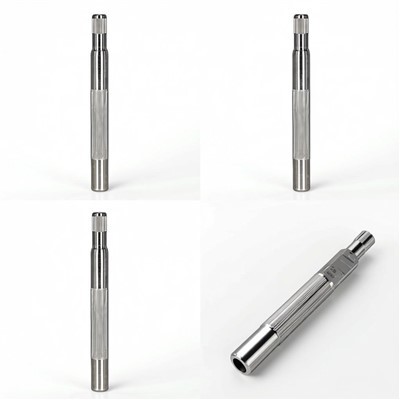

Theoretically, the motor shaft should not be electrically charged, and naturally, no current should flow through it. However, for high-voltage motors, low-voltage high-power motors, and variable-frequency motors, shaft currents do exist, although the magnitude of the motor shaft current varies.
During actual testing and operation of motors, it can be observed that some motor shafts exhibit magnetization, meaning they have a certain attractive force on tiny iron particles, which is particularly harmful to the motor's bearing system.
The necessary conditions for generating shaft current are shaft voltage and a closed circuit. Shaft voltage is the voltage induced on the motor shaft due to factors such as asymmetry in the motor's magnetic field. When a closed circuit is present, a significant shaft current is generated.
Magnetic circuit asymmetry, capacitive coupling in the motor's rectification and inversion systems, electrostatic induction, axial magnetic flux, and residual magnetism can all lead to the generation of shaft voltage. The shaft voltage caused by magnetic circuit asymmetry is an alternating voltage present at both ends of the motor shaft. For large motors, asymmetry caused by manufacturing and operating reasons such as the use of sector-shaped laminations in the stator core, rotor eccentricity, different magnetic permeability of the laminations, and axial guide grooves for cooling and clamping, generates an alternating magnetic flux that links the rotating shaft, creating a potential difference at both ends of the motor shaft. This AC shaft voltage generally does not exceed 10V, but it carries considerable energy. If effective measures are not taken, the shaft voltage will form a circuit through the bearing system, generating a large shaft current, leading to electrical breakdown of the motor's bearing system.
In controlling motor shaft currents, necessary circuit breaking or bypass measures should be adopted depending on the motor type and application. The level of shaft voltage is generally used as the basic criterion for deciding whether to take measures. Some foreign motor technical documents use 350 millivolts as the threshold for shaft voltage prevention. That is, when the shaft voltage does not reach this value, it will not have a significant impact on the motor's bearing system, but exceeding this value is highly likely to cause serious problems in the bearing system.