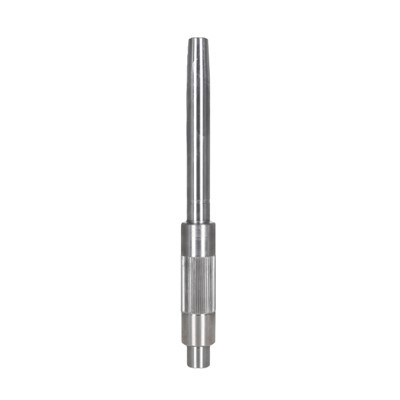


Hey there! As a supplier of Bare Shaft Water Pumps, I often get asked about how to calculate the power required for these pumps. It's a crucial aspect, whether you're using them for agricultural, fire - fighting, or hydraulic applications. So, let's dive right into it.
Understanding the Basics
Before we start calculating the power, we need to understand what a bare shaft water pump is. A bare shaft water pump is a type of pump where the shaft is directly connected to the power source, like an electric motor or an engine. This setup gives you more flexibility in choosing the power source according to your needs.
Factors Affecting Power Requirements
There are several factors that influence the power required for a bare shaft water pump.
Flow Rate (Q)
The flow rate is the volume of water that the pump moves in a given time. It's usually measured in cubic meters per hour (m³/h) or gallons per minute (GPM). The higher the flow rate you need, the more power the pump will require. For example, if you're using the pump for large - scale agricultural irrigation, you'll need a high flow rate, which means a more powerful pump.
Head (H)
The head refers to the height to which the pump can lift the water. It's measured in meters (m) or feet (ft). The greater the head, the more power is needed to overcome the gravitational force and push the water up. If you're pumping water from a well to an elevated tank on a farm, the head will be significant, and thus, the power requirement will increase.
Efficiency (η)
Pump efficiency is a measure of how well the pump converts the input power into useful work. No pump is 100% efficient. Some energy is lost due to factors like friction, leakage, and mechanical losses. The efficiency is usually expressed as a percentage. A more efficient pump will require less power to achieve the same flow rate and head compared to a less efficient one.
The Power Calculation Formula
The formula to calculate the power required for a water pump is:
[P=\frac{\rho\times g\times Q\times H}{\eta}]
Where:
- (P) is the power in watts (W)
- (\rho) is the density of water. For water at room temperature, (\rho = 1000\ kg/m³)
- (g) is the acceleration due to gravity, which is approximately (9.81\ m/s²)
- (Q) is the flow rate in (m³/s) (you may need to convert from (m³/h) or GPM)
- (H) is the head in meters
- (\eta) is the pump efficiency
Let's break this down with an example. Suppose you have a pump with a flow rate (Q = 10\ m³/h), a head (H = 20\ m), and an efficiency (\eta= 0.7) (or 70%).
First, convert the flow rate from (m³/h) to (m³/s):
[Q=\frac{10}{3600}\ m³/s\approx0.00278\ m³/s]


Now, use the formula:
[P=\frac{1000\times9.81\times0.00278\times20}{0.7}]
[P=\frac{1000\times9.81\times0.0556}{0.7}]
[P=\frac{545.436}{0.7}\approx779.2\ W]
Different Applications and Power Requirements
Agricultural Applications
In agriculture, water pumps are used for irrigation. The power requirement depends on the size of the farm, the type of crops, and the irrigation method. For small - scale farms, a pump with a lower power may be sufficient. However, for large commercial farms, high - power pumps are needed. You can check out our Agricultural Pump Shaft for more details on pumps suitable for agricultural use.
Fire - Fighting Applications
Fire pumps need to provide a high flow rate and head to effectively fight fires. They are often required to deliver water over long distances and to high - rise buildings. The power requirements for fire pumps are usually quite high. Our Fire Pump Shaft is designed to meet the demanding needs of fire - fighting applications.
Hydraulic Applications
Hydraulic pumps are used in various industrial and mobile equipment. The power required depends on the pressure and flow rate needed for the specific hydraulic system. Our Hydraulic Pump Shaft is engineered to handle the unique requirements of hydraulic applications.
Tips for Accurate Power Calculation
- Measure accurately: Make sure you measure the flow rate and head as accurately as possible. Any errors in these measurements can lead to incorrect power calculations.
- Consider system losses: In addition to the pump efficiency, there may be losses in the piping system, such as friction losses. These losses should be factored into the power calculation.
- Choose the right pump: Select a pump with an appropriate efficiency for your application. A high - efficiency pump will save energy and reduce operating costs in the long run.
Wrapping Up
Calculating the power required for a bare shaft water pump is not as complicated as it may seem. By understanding the factors involved and using the right formula, you can determine the power needed for your specific application. Whether you're in agriculture, fire - fighting, or hydraulic industries, having the right pump with the correct power is essential for efficient operation.
If you're interested in purchasing our Bare Shaft Water Pumps or need more information on power calculations, feel free to reach out to us. We're here to help you find the perfect pump for your needs.
References
- "Pump Handbook" by Igor J. Karassik et al.
- "Fluid Mechanics" by Frank M. White.